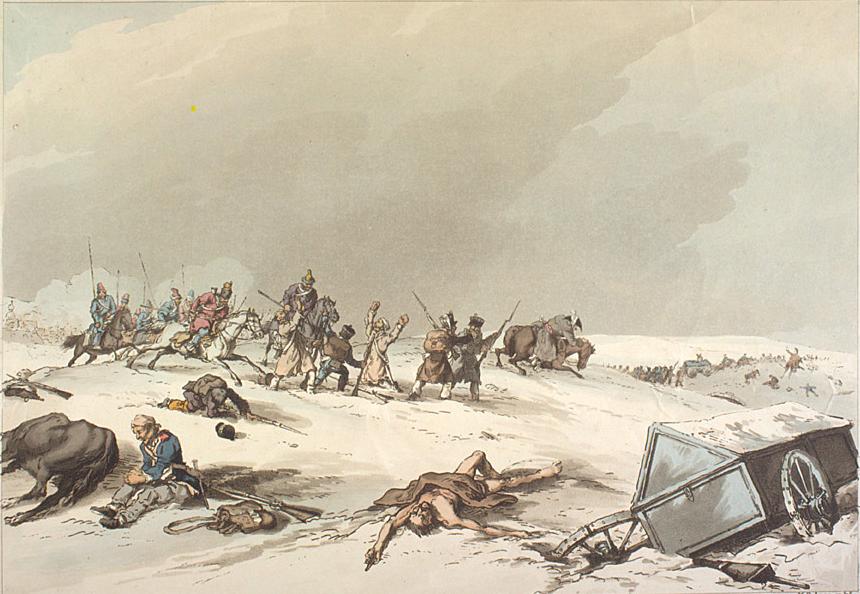
Napoleon Bonaparte’s Grande Armée invaded Russia on June 24, 1812, with an estimated 600,000 troops. Of those, it is estimated that 500,000 were killed, deserted, or captured during the invasion. A very small number of those captured soldiers were allowed to work in the Volga German colonies. Of those, 182 are documented to have settled permanently in Volga German villages.
There is a considerable amount of published research on these Napoleonic soldiers. The Geschichte der Wolgadeutschen web site has many documents and links posted under the forum topic “Военнопленные армии Наполеона в Поволжье” (“Prisoners of war of Napoleon's army in the Volga region”). Of the items posted there, the one that I found most interesting from a genealogy perspective is a paper written by B.P. Milovidov titled "ВОЕННОПЛЕННЫЕ НАПОЛЕОНОВСКОЙ АРМИИ В САРАТОВСКИХ КОЛОНИЯХ В 1813–1820 гг.: НОВЫЕ МАТЕРИАЛЫ" (“Prisoners of War of the Napoleonic Army in the Saratov Colonies in 1813-1820: New Documents”).
The Milovidov paper is divided into three sections. The first section provides an overview of the archival sources and previous research on the topic, and a lengthy discussion of the administrative process of accepting prisoners as workers in the colonies and assigning those prisoners to specific Volga German villages. There is also a summary of what is known about the prisoners: how many worked in the colonies, where they came from in Europe, their professions, religions, ages, and which colonies they worked in and settled in.
The second section of the paper is a table that provides individual details about each of the 182 prisoners. The information provided varies for each soldier, but most of the entries include the following data:
- First and last name
- The country or region he came from
- His religion
- The name of the city or town he came from
- His age
- What regiment of the military he served in, his rank, and how many years he served
- Whether he was single or married
- Whether he left behind parents, a wife, or siblings
- Whether he was literate, what language(s) he spoke, and his profession
- Which colony he was sent to and who he went to work for
The third section is another table, this one arranged in order of the dates that the men decided that they wished to stay in the colonies. The previous table listed where some of the men initially went to work, which isn’t necessarily the same place that they permanently settled. This table includes the following information:
- The number of the individual from the previous table
- First and last name
- The name of the colony each settled in
- The date they each agreed to settle permanently in the colonies
If one of these men is your ancestor, the information provided in this paper makes it possible to locate his birth location. Here are two examples of research done to identify the birth location of specific prisoners:
Friedrich Altag was one of two Napoleonic War prisoners who settled in Messer. There isn’t a Friedrich Altag listed in the Milovidov paper, but there is a Johann Altag. Johann Altag is described as a Lutheran from Westphalia, 24 years old. The name of the town he came from is stated as “Клейнбрамин” in Russian, which translates roughly into “Kleinbramin”. A place with that exact name does not exist in Westphalia, but there is a place called Kleinenbremen. The tables also state that he has a mother and sister in “Kleinbramin” and nine brothers in the Westphalian service. The village chronical of Kleinenbremen includes a list of men believed to have died during Napoleon's invasion of Russia, including Friedrich Altag and his brother Carl Altag. Friedrich and Carl were among the ten sons of Johann Daniel Altag recorded in the Kleinenbremen parish records. The village chronical and church records of Kleinenbremen are both available on the German church records website Archion.
Michael Alexander was one of two Napoleonic War prisoners who settled in Norka. The tables in the Milovidov paper state that he was a Lutheran from Strasbourg in the Alsace region, 23 years old. Additionally, the Norka Communion Registers state that he was from “Merkweiler in Elsas”. Many of the records from that area are indexed on Family Search, and those indexes were helpful in identifying his actual birth location as Mitschdorf, which is a few miles away from Merkweiler. The church records for this area are also available on the Archives d'Alsace web site.
There are two additional sources that might be of interest to those researching Napoleonic era soldiers. One is an ongoing project on the Geneanet website to index the muster rolls of Napoleon's Grande Armée. The other is the website of the French Army which has a searchable database of individuals that have served in the French military starting in the late 1600s.
Sources:
- Mikaberidze, Alexander. “Napoleon’s Lost Legions. The Grande Armée Prisoners of War in Russia” pages 35-44.
- French invasion of Russia – Napoleonic Wars [1812]. Brittanica Online. Accessed 5 January 2025.
- List of Napoleon's 181 Soldiers Settled in Volga German Colonies. GASO, the State Archive of Saratov Oblast.
- Geschichte der Wolgadeutschen web site, forum topic “Военнопленные армии Наполеона в Поволжье” (“Prisoners of war of Napoleon's army in the Volga region”)
- Milovidov, B.P. ВОЕННОПЛЕННЫЕ НАПОЛЕОНОВСКОЙ АРМИИ В САРАТОВСКИХ КОЛОНИЯХ В 1813–1820 гг.: НОВЫЕ МАТЕРИАЛЫ (“Prisoners of War of the Napoleonic Army in the Saratov Colonies in 1813-1820: New Documents”.)
- Archion Kirchenbuchportal
- FamilySearch
- Archives d'Alsace
- Geneanet Index of the muster rolls of Napoleon's Grande Armée
- French Army “Memoire des Hommes” database
- Genealogy research on Michael Alexander, a settler in Norka
- Genealogy research on Friedrich Altag, as settler in Messer